
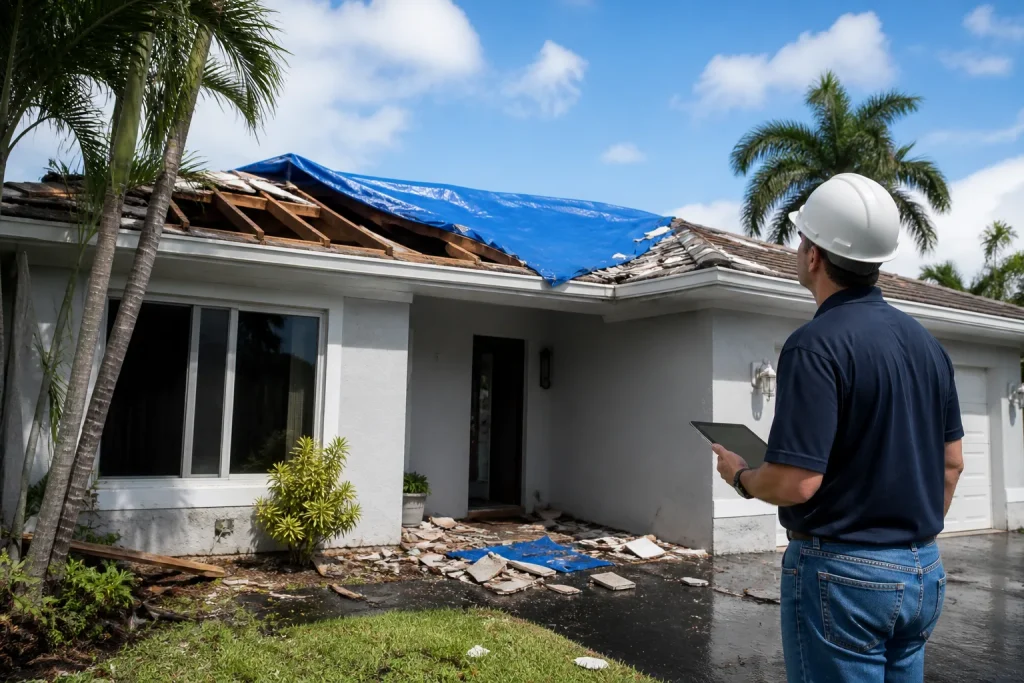
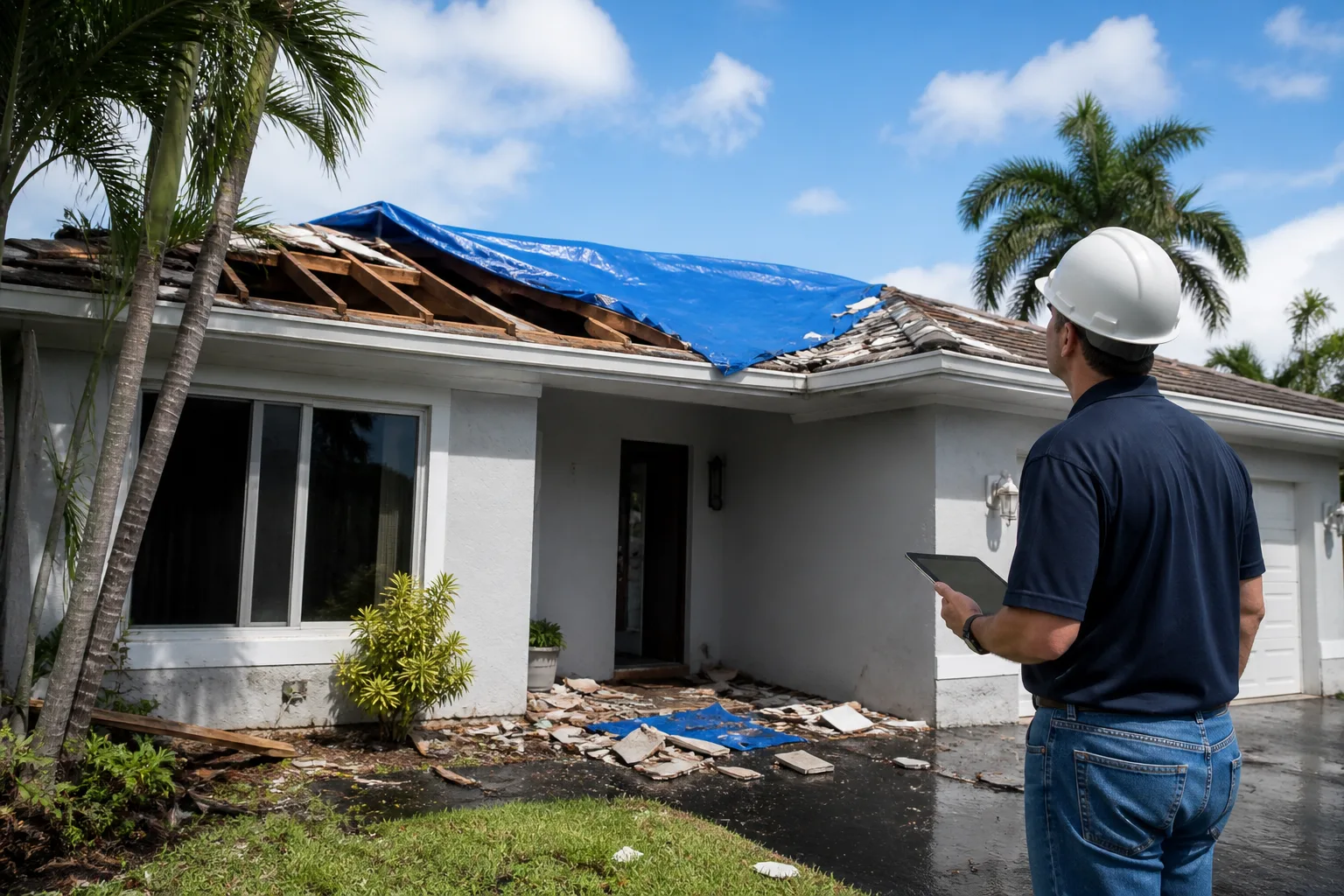
Emergency General Contractor Near Me: What Cutler Bay Homeowners Should Do First
If a contractor arrives at your emergency before you’ve photographed and documented the damage yourself, the scope of work they write is based on their assessment alone, and that’s the number your insurance adjuster will see first. That single ordering mistake costs Cutler Bay homeowners more than the storm did. The sequence that protects you is boring and takes eleven minutes: stop the water or secure the opening if you safely can, then document, then call. Below is what that first hour should look like, and what to demand from whoever you let through the door.
If you’d rather have someone walk you through it right now, call (833) 620-5491. A live person answers, day or night.
What Should You Do in the First Hour of a Construction Emergency in Cutler Bay?
Work in this order: make it safe, stop the damage, document everything, then call. Most people do steps three and four in the wrong order, and it costs them at claim time. Cutler Bay sits on some of the lowest ground in Miami-Dade, so water is almost always part of the story, whether it started as a roof leak or a supply line. Here’s the hour, step by step.
- Make it safe. If you smell gas, see a downed line, or a ceiling is sagging or ballooning, get everyone out and call 911 and your utility first. Do not walk under a bulging drywall ceiling to take pictures. It lets go without warning.
- Stop the water. Shut the main valve if a supply line failed. If it’s a roof leak, get buckets down and move furniture, electronics, and anything paper off the floor. In Cutler Bay, don’t just mop and forget it: humidity here holds at the kind of level that grows mold inside a wall cavity in about 48 to 72 hours.
- Photograph before you clean. Wide shot of the room, medium shot of the damage, close-up with something for scale. Get the ceiling, the floor, and the wall in the same frame where you can. Video a slow pan of each affected room. Date-stamp matters.
- Write it down. What time you found it, what you did, what you moved. A paragraph on your phone is enough.
- Call your insurer’s claim line and open the file before you call a contractor, so the claim exists before anyone’s scope does.
- Then call a contractor for stabilization.
That’s it. Eleven minutes of your time and you’ve locked the narrative in your favor.
How Do You Document Damage So Your Claim and Your Contractor’s Scope Match?
Your goal is a photo record detailed enough that a contractor’s written scope can only confirm it, not define it. When the two documents tell the same story, the adjuster has nothing to arbitrate and the price moves less. When they don’t, you get a back-and-forth that stalls the repair for weeks. Three things make the difference.
- Photograph the cause, not just the result. The failed supply line, the cracked flashing, the tree limb. Adjusters pay for cause plus consequence. A stained ceiling with no photo of what let the water in is a weaker file.
- Get the moisture readings in writing. A contractor with a moisture meter should give you the readings, room by room, in the scope. Those numbers are what justify drying equipment and, if it comes to it, replacing drywall that looks fine but reads wet. That’s the difference between remediating a wall and rebuilding it.
- Keep a paper trail of every conversation. Who you talked to, when, what they said about scope. In our experience, the homeowners who come out clean on a claim are the ones who can produce a one-page timeline.
One more Cutler Bay specific: if your home is in one of the older sections near the bay where the housing stock dates back decades, photograph the age of adjacent materials. A 30-year-old cabinet run and a brand-new one don’t match, and the scope has to say so up front or you’ll be arguing about it in month two.
What Does “Emergency Contractor” Licensing Actually Require in Florida?
Florida does not issue an “emergency contractor” license. There is no such credential. What exists is a state-certified or registered general contractor, and separately a licensed mold remediator and a licensed roofing contractor for their respective scopes. Anyone who shows up after a storm claiming an emergency certification is either misinformed or counting on you not knowing the difference.
Here’s the practical test. Ask for the license number, then look it up yourself on the Florida DBPR license search before you sign anything. It takes two minutes. A state-certified general contractor’s license will show there. A registered contractor is licensed for a specific local jurisdiction only. What you’re looking for in Cutler Bay:
- A real, verifiable license number that matches the company name on the contract, not a subcontractor’s number or a “we work under” arrangement.
- Certificate of insurance showing general liability and workers’ comp, sent directly from the insurer or agent. Not a photocopy the crew carries.
- A written contract with a scope and price before work starts. Florida law requires certain disclosures in home repair contracts, and a licensed contractor will have them.
- A local business presence and a local permit history. Storm-chasers roll in after a weather event and are gone before the punch list. A contractor with permits pulled in Cutler Bay is a contractor who plans to be around to close them.
Unlicensed crews quote low and disappear. They can’t pull permits, so work gets done without inspection, and when you go to sell, the unpermitted work becomes the buyer’s leverage against your price. We’ve seen it on properties near Cutler Bay’s older neighborhoods, where a quick unpermitted rebuild turned into a disclosure problem at listing.
What’s the Difference Between Emergency Stabilization and Full Remediation?
Stabilization stops the bleeding. Remediation fixes the wound. They are two different scopes with two different price tags, and bundling them into one lump sum is how homeowners lose negotiating room. Insist on separate written numbers even if you sign one combined contract.
| Scope | What it covers | Typical Cutler Bay range |
|---|---|---|
| Emergency stabilization | Tarps, temporary shoring, water extraction, board-up, weatherproofing an opening | $350 – $1,800 depending on extent |
| Structural repair | Framing, substrate replacement, drywall rebuild after drying | $1,200 – $6,500 per affected area |
| Mold remediation | Containment, removal, HEPA and air scrubbing, clearance testing | $1,400 – $4,800 |
| Full replacement | Rebuild of an affected room to pre-loss condition | $8,000 – $35,000+ |
Those ranges are real numbers for this market and they move with the size of the loss, access, and material choices. The point isn’t the exact figure. The point is that stabilization is the only piece that’s genuinely time-critical. Everything after it can wait for a written scope, a written price, and a conversation with your adjuster.
And this is the part the damage-first sequence protects: once you have your own photos in hand, you can authorize stabilization work without forfeiting control of the bigger remediation scope. You bought the bandage. You didn’t hand over the surgery.
How Do You Get a Written Scope and Price Without Delaying Urgent Work?
You authorize stabilization on a written work order, in writing, with a defined scope and a defined price, and you hold the remediation scope for review. That’s the whole trick. A contractor who won’t put a tarp and a price in writing before touching the roof is telling you something important about how the remediation conversation will go.
What a legitimately squared-away contractor hands you before any tool comes out: a written price, a defined scope of work, and a stated guarantee. At Bradford Remodeling Co Cutler Bay, every project gets a written price before work begins, and every completed job is covered by the 365-Day Done Right Promise: if the work fails inside that year, we come back and correct it at no charge. That’s true of emergency stabilization too. The paper trail doesn’t pause because the water is rising.
The other thing to ask about in an emergency is materials. When a Therma-Tru door or a Barrette fence panel gets ordered on the fly, you want a model number and a manufacturer warranty in the scope, not a vague “like kind and quality.” Documented specifications mean the adjuster sees exactly what’s being replaced and you can verify it at install.
Need a bathroom or kitchen rebuilt after the water got in? Those are separate, planned scopes and they should be priced that way.
When Should You Call a Pro in Cutler Bay?
Call a pro the moment the damage crosses any of these lines: water has reached inside a wall or under flooring, a structural member is involved, the opening can’t be secured by a homeowner with a tarp and a ladder, or there’s any electrical or gas component. For a small puddle under a clean sink, dry it and monitor. For anything touching framing, roofing, or a supply line you can’t reach, get a professional on it.
If you’re reaching out to us, we’ll ask for your photos first. Not because we don’t believe you, but because a scope built from your record plus our site visit tells the same story twice. Bradford Remodeling Co Cutler Bay is a member of the Garrison Partners family, established in 2004, and operates as an independently owned and operated business held to The Garrison Standard. Our technicians have up to 22 years of experience. Every completed job comes with the written guarantee in your hand at close, and we answer the phone with a real person around the clock.
For a wider look at what we do, start with Bradford Remodeling Co Cutler Bay home, and our full General Contractor in Cutler Bay page covers planned work and remediation scope.
Related services in Cutler Bay
- Kitchen Remodeling in Cutler Bay for post-water-damage kitchen rebuilds.
- Bathroom Remodeling in Cutler Bay for supply-line and shower-pan failures.
The Bottom Line
Documentation comes first, contractor second. Photograph the damage, open your insurance claim, then hire for stabilization on a written work order with a written price. Ask for the license number and look it up. Keep stabilization and remediation scoped separately so the price doesn’t move on you mid-job. That sequence costs you eleven minutes and keeps control of the claim in your hands.
If you’re in Cutler Bay and need help, Bradford Remodeling Co Cutler Bay offers free estimates. Call (833) 620-5491. A live person picks up 24/7, and every price you get is in writing before any work starts.
Frequently Asked Questions
No. Call your insurer first so the claim file exists before any contractor’s scope is written. Your own photos and your own description shape the file; a contractor’s assessment should confirm your record, not create it. If the damage is actively worsening, stop the water or secure the opening yourself if it’s safe, then make both calls in either order. Call (833) 620-5491 and we’ll tell you honestly whether you need us today.
No. Florida issues state-certified and registered contractor licenses, not an “emergency” designation. Anyone claiming emergency contractor certification should be asked for a license number, and you should look it up on the Florida DBPR site before signing anything. A legitimate contractor in Cutler Bay will give you the number without hesitation and carries liability and workers’ comp coverage you can verify.
Plan on 48 to 72 hours in this climate. Cutler Bay’s humidity keeps wall cavities damp long after the surface looks dry, so extraction and drying need to start quickly. If the water reached inside a wall or under flooring, get moisture readings in writing as part of the scope. That document is what justifies drying equipment or drywall replacement when the surface looks fine.
You get it before work starts, no exceptions. Stabilization gets its own written work order with a defined scope and a defined price; full remediation gets a separate written scope. Any contractor who wants to start without putting a number on paper is telling you how the rest of the job will go. Call (833) 620-5491 for an exact written estimate, free.
Written by the team at Bradford Remodeling Co Cutler Bay.
Need Construction Help?
Call Bradford Remodeling Co Cutler Bay - licensed & insured, here with fast after-hours help in Cutler Bay.
(833) 620-5491